Control domain
Manager, operator experience, Identity, Policy, fleet, configuration, release evidence, Studio, entitlement, and global reporting.

Architecture
The architecture separates control-domain authority, regional model capacity, site-local execution, endpoint participation, enterprise systems, and approved external services.
Baseline v1.0.0
Each mutable record has one accepting authority. Models and structured decisions provide proposals; Identity, Policy, EL-Flow and Action Fabric retain their respective admission and execution roles.
Deployment qualification binds the exact release, hardware, models, workload and enabled profile. Published architecture does not by itself establish production availability, performance or certification.
Request the Architecture GuideReference architecture
The Manager and control domain govern identity, policy, configuration, release evidence, fleet state, and global reporting. Site and regional services carry the low-latency workload after they receive valid policy, artifacts, identities, and capacity.
Manager, operator experience, Identity, Policy, fleet, configuration, release evidence, Studio, entitlement, and global reporting.
Shared inference, model routing, retrieval hotsets, telemetry aggregation, artifact service, and regional continuity.
Local context, cache, retrieval, qualified models, bounded workflows, evidence outbox, network participation, and offline continuity.
Device identity, outbound secure channel, telemetry and posture, encrypted local buffering, and device-bound action leases.
ERP, CRM, ITSM, CMDB, identity, network, security, finance, documents, SaaS, and line-of-business systems remain sources of record.
Eligible models, SaaS APIs, publishers, and partner services are explicit routes with data, provider, budget, and evidence controls.
Your data
Three rules shape everything here. Your systems remain the sources of record. Every kind of record inside EL-Ai-NE has exactly one accepting owner. Withdrawing a right outranks any reuse.
| Data | Where it lives | How it is treated |
|---|---|---|
| Your enterprise records: tickets, documents, configurations, device state | Your source systems | Read through admitted connectors under the source's own permissions. They remain the system of record. |
| Source snapshots and prepared evidence | The Brain Trust store in the control or regional services; a hot set at the site where placement allows | Stored with origin, rights and retention. Invalidated when the source changes or rights are withdrawn. |
| Search, vector and graph indexes | Site and regional hot sets; control services | Can always be rebuilt. The same access rules apply as to the source. |
| Accepted operational state: entities, assertions, contradictions, cases | The operational record in the control services; a readable cache at the site | Earlier and conflicting assertions are preserved, never overwritten by a dashboard. |
| Workflow progress, waits and human tasks | The workflow journal | Survives restarts and client disconnects. |
| Action requests, approvals, executions and verifications | The action journal | Immutable receipts. An unknown outcome is reconciled, not retried. |
| Policy and its versions | Policy services; signed, expiring copies cached at sites | A site can decide locally only inside the lease of its signed copy. |
| Governance evidence, receipts and tombstones | The governance ledger | Signed and append-only. Tombstones outrank every cache, index and backup. |
| Prompts and responses | The memory of the model runtime, for the life of the request | Not kept by default. Kept for 0 to 30 days only when justified. |
| Answer and context caches | Site and regional nodes | Scoped to permissions and policy version. A correction or revocation invalidates dependent entries. |
| Models and their supporting files | The artifact store; a cache at the site | Fixed by digest and signed. Live business facts are never baked into a model. |
| Usage, cost and outcome facts | Cost and outcome stores | Exact and append-only. A closed period is corrected only by a restatement. |
| Metrics, traces and logs | A local agent at the site; a telemetry store in the region or control services | Identifiers, sizes and result codes only. No prompts, documents or secrets. |
| Secrets and keys | Your approved key management service or HSM | Issued as a narrowly scoped, short-lived lease at the moment of use. |
| Backups | A restricted, encrypted location with separate key custody | Checked before restore. Current tombstones are applied before restored data can be read. |
Corrections, revocations and tombstones travel to every derivative: caches, indexes, generated pages, decisions and restored backups.
Being able to read something is not permission to do anything else with it. Capture, transient processing, transcription, translation, regional routing, external routing, storage, disclosure, memory, evaluation, training, synthetic derivation and cross-tenant contribution are each granted and checked on their own. No model is trained because a document was readable for answering a question.
| Record | Planning starting point |
|---|---|
| Raw prompts and responses | Not kept by default; 0 to 30 days only when justified. |
| Detailed site telemetry | 7 to 30 days, kept locally. |
| Aggregated operational telemetry | 90 to 365 days, kept centrally. |
| Operational record assertions and cases | 1 to 3 years, or your own lifecycle. |
| Action, approval and governance evidence | 1 to 7 years, according to consequence and regulation. |
| Model, evaluation and deployment evidence | The life of the artifact plus the rollback and audit period. |
| Cost and invoice evidence | Your accounting retention policy. |
| Operational backups | A short rolling window locally; typically 30 to 90 days centrally, plus an approved archive. |
Configurable starting points from the baseline, not compliance requirements. Your retention policy is an owner decision; until it is set, the affected capability stays disabled.
A deletion is reported as one of seven honest states instead of a single "done": accepted by the owner, propagation in progress, local copy invalidated, physical deletion complete, backup expiry pending, blocked by a legal hold, or failed. A restore can never bring deleted or revoked content back, because current tombstones are applied before restored data can be read.
Status at Baseline v1.0.0. The governance ledger, audit record, tombstones and usage metering are Available now. Database-enforced tenant separation, data classification, retention bundles and signed backups are Included, enabled per qualification. On current installs, chat sessions are also saved to disk, and the knowledge store does not yet accept your own documents; plan a proof of concept accordingly.
Authority chain
Every material request moves through a structured chain that prevents a model, connector, UI, or endpoint client from becoming an accidental control plane.
Governance authority integration
Governance records inform what must be enforced. Identity, Policy, EL-Flow, Action Fabric, the operational record, Studio, release integrity, Privacy, Cost, Outcome, and Observability continue to own and enforce their existing technical state.
Design principles
During disconnection, source gaps, unqualified models, stale policy, or capacity pressure, EL-Ai-NE narrows, delays, refuses, or marks the result unknown. It never silently expands permissions to keep an automation moving.
Models and agents remain proposal components.
Missing or stale telemetry remains unknown or degraded.
Execution acknowledgement does not prove the target state.
Production and outcome claims bind to exact artifacts, profiles, tests, and operating windows.
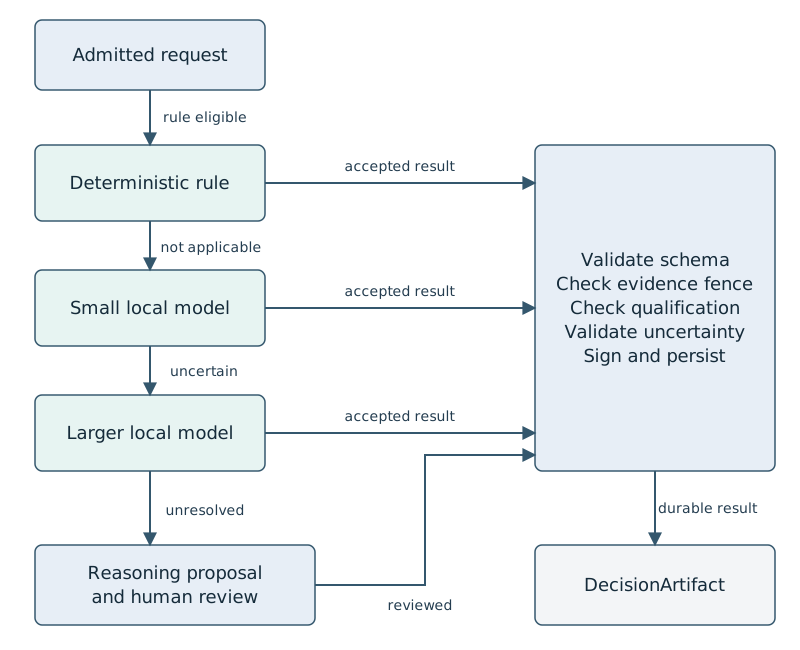
Structured Decision Intelligence Planned
An immutable decision definition sets the question, candidate meanings, required evidence and permitted consequence.
Use deterministic rules when sufficient, then eligible local or regional models. Review or abstain when evidence or calibration is insufficient.
EL-Flow checks current evidence, rights, qualification and policy before using a result. A decision cannot authorize an action.
Governed Web Experiences Planned
A page composer assembles approved components from versioned evidence. A freshness coordinator handles freshness and invalidation. The interface serves the accepted view only after current audience, source-right and dependency checks. A failed refresh never renews freshness, and restored content must pass current revocation and tombstone checks.
Persistent Agent Workspace retains workspace preferences and routine definitions while EL-Flow owns durable execution. Each trigger and collaboration handoff rechecks authority.